How it works
PongAI reads a match from body movement alone. It never tracks the ball, and it needs nothing but a video.
Everything below is drawn from the same analysed match you can open from the home page.
- 3 minutes
- Recording
- 10
- Rallies found
- 40
- Shots detected
- 13
- Measurements each
You upload a match
A side-on video, up to 100 MB and five minutes. The file is measured in your browser first, so a clip that cannot work is caught before it is uploaded rather than after.
The rallies are found
Most of a recording is people picking up the ball. A detector samples the video and keeps only the stretches where both players are present and moving, so nothing downstream is spent on the gaps. The player then offers a Show only rallies switch, which skips straight from one point to the next.
In this match, 19 seconds of play inside a 3-minute recording.
0:00orange = a rally in progress3:00 The gaps are gone. The same 10 rallies run back to back, and the clock and the timeline follow the rallies rather than the file. Both players are tracked
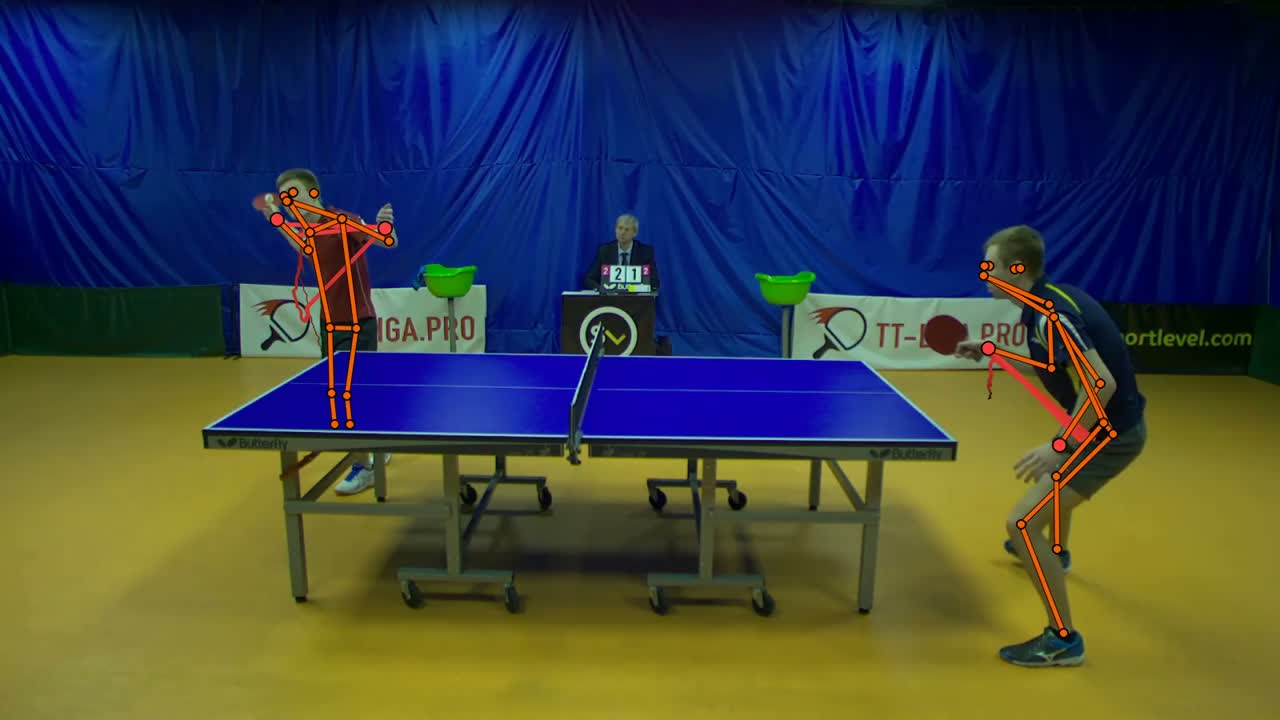
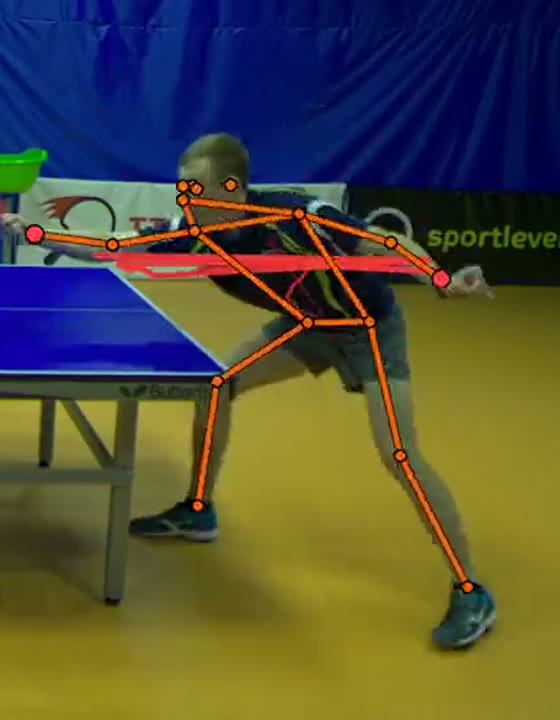
A pose model follows seventeen body joints for each player, frame by frame. It works from a tight crop around each of them rather than the whole frame, which is substantially more accurate.
Shots are detected and attributed
A temporal model reads the motion and marks the moment of contact to within a few hundredths of a second, then decides which player played it. Attribution is right 99.4% of the time.
40 shots across 10 rallies, each placed on the side of whoever hit it.
Left player above the line, right below. Faint marks are labels PongAI is not confident enough to act on. Strokes are classified and measured
Each shot gets one of four labels, serve, attack, control or defence, with a calibrated confidence, plus thirteen measurements taken from the body alone.
Attackloop98% confident- Elbow angle
- 16°
- Trunk rotation
- 128°
- Backswing
- 1.15 torso lengths
- Contact height
- -0.06 vs the shoulder line
Four of thirteen measurements, from one shot at 120fps.
What it cannot tell you
Stated plainly, because a measurement you cannot trust is worse than one you do not have.
Spin, racket angle, ball placement
None of these are in the body. PongAI never sees the ball, so it cannot tell you where you put it or what you did to it.
Swing speed below 60fps
The wrist-speed peak is about 33ms wide. At 30fps it is sampled once and under-measured by roughly half, so those four metrics are withheld rather than estimated.
Two of the four stroke labels
Control is right about 80% of the time and defence about 56%. They are shown and counted, but no conclusion is drawn from them.
Footage that is not side-on
One table, both players in frame, camera steady and level with the table. A moving camera or an angled view breaks the geometry the whole thing rests on.
Open the full analysis to see all of this on the real match. It loads instantly, and nothing is uploaded.